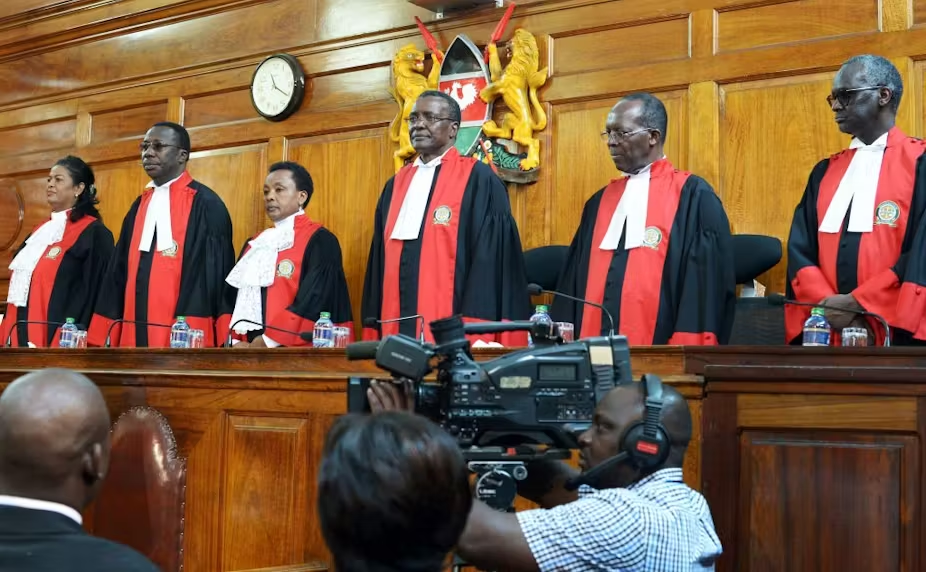
The Kenyan judiciary plays a vital role in upholding the rule of law, ensuring justice, and protecting the rights of citizens. As one of the three arms of government—alongside the Executive and the Legislature—the judiciary operates independently under the Constitution of Kenya, 2010. But how exactly does the Kenyan judiciary system work?
In this article, we break down the structure, roles, and functions of the judiciary in Kenya.
1. Constitutional Foundation
The Kenyan judiciary derives its authority from Chapter 10 of the Constitution of Kenya (2010). The constitution guarantees judicial independence, meaning no individual or institution can interfere with the decisions made by judges and magistrates.
2. Key Principles of the Judiciary
The judiciary operates on the following core principles:
- Justice shall be done to all, irrespective of status.
- Justice shall not be delayed.
- Alternative forms of dispute resolution (ADR) are promoted.
- Courts must remain accessible and promote fairness.
3. Structure of the Kenyan Judiciary
The judiciary consists of several courts, each with a specific role and jurisdiction:
a) Supreme Court
- Highest court in Kenya
- Deals with presidential election petitions, constitutional interpretation, and matters of national importance.
- Composed of the Chief Justice, Deputy Chief Justice, and five other judges.
b) Court of Appeal
- Handles appeals from the High Court and other lower courts.
- Sits in panels of three judges.
- Located in major cities like Nairobi, Mombasa, Kisumu, and Eldoret.
c) High Court
- Has unlimited original jurisdiction in civil and criminal matters.
- Handles constitutional petitions, human rights cases, and judicial reviews.
- Divided into specialized divisions such as:
- Family & Children
- Commercial
- Constitutional and Human Rights
- Anti-Corruption & Economic Crimes
d) Environment and Land Court (ELC)
- Deals with matters relating to land use, land ownership, and environmental protection.
e) Employment and Labour Relations Court (ELRC)
- Handles disputes between employers and employees, trade unions, and labour-related cases.
f) Magistrates’ Courts
- Handles minor civil and criminal cases.
- Found across all counties in Kenya.
- Jurisdiction is limited by the magnitude of the offense or claim.
g) Kadhi’s Courts
- Operate under Islamic law (Sharia).
- Handle personal law matters (e.g., marriage, divorce, and inheritance) for Muslims only.
4. Key Officers in the Judiciary
a) Chief Justice (CJ)
- Head of the judiciary and president of the Supreme Court.
- Oversees the administration of justice in Kenya.
b) Judicial Service Commission (JSC)
- A constitutional body that recruits judges and magistrates, disciplinary actions, and promotes judicial reforms.
c) Registrar of the Judiciary
- Handles administrative functions, such as budgeting, HR, and infrastructure.
5. How Cases Move Through the System
- Filing of a case: Done at the relevant court registry.
- Hearing and determination: Involves presentation of evidence and witness testimonies.
- Judgment or ruling: Court issues a verdict based on law and evidence.
- Appeals process: If dissatisfied, a party can move to a higher court for review.
6. Alternative Dispute Resolution (ADR)
Kenya’s judiciary encourages ADR methods like:
- Mediation
- Arbitration
- Reconciliation
These are faster, cost-effective, and reduce court backlog.
7. Judicial Reforms and Technology
In recent years, the Kenyan judiciary has embraced technology:
- E-filing of cases
- Virtual court sessions
- Digitization of court records
These efforts aim to enhance transparency, efficiency, and access to justice.
Final Thoughts
The Kenyan judiciary is a cornerstone of democracy, offering a structured and independent mechanism for resolving disputes and upholding justice. With continuous reforms, a focus on efficiency, and increased access through technology, Kenya’s judicial system is evolving to better serve its citizens.
Whether you’re a student, lawyer, or an ordinary citizen, understanding how the judiciary works helps you better navigate your rights and responsibilities under the law.